
Verdict & Pricing Snapshot
| Jasper Pro | Writesonic Starter | |
|---|---|---|
| Starting price | $69/seat/mo monthly; $59/seat/mo annual ($708/seat/yr) | $99/mo monthly; $79/mo annual |
| Free tier | None | None — old free tiers have been dropped |
| Free trial | 7-day free trial on Pro | Free trial, no credit card required |
| Core limit | 2 Brand Voices, 5 Knowledge assets, 3 Audiences | 15 AI articles/mo, 50 tracked prompts, 10 site audits/mo |
| Who should skip | Teams that need more than one seat without a sales conversation | Anyone who only needs a general AI writer |
The short answer: Jasper wins if your main problem is producing on-brand marketing copy with a consistent voice. Writesonic wins if your main problem is search visibility — tracking how your brand shows up in AI answers and auditing your site — and you are comfortable paying more per month for fewer articles. They are no longer the same kind of tool, even though both started as AI writers. If you only need one of those jobs done, buy the tool built for that job; if you need both, budget for both, because neither one replaces the other cleanly in 2026.
What each tool actually is in 2026
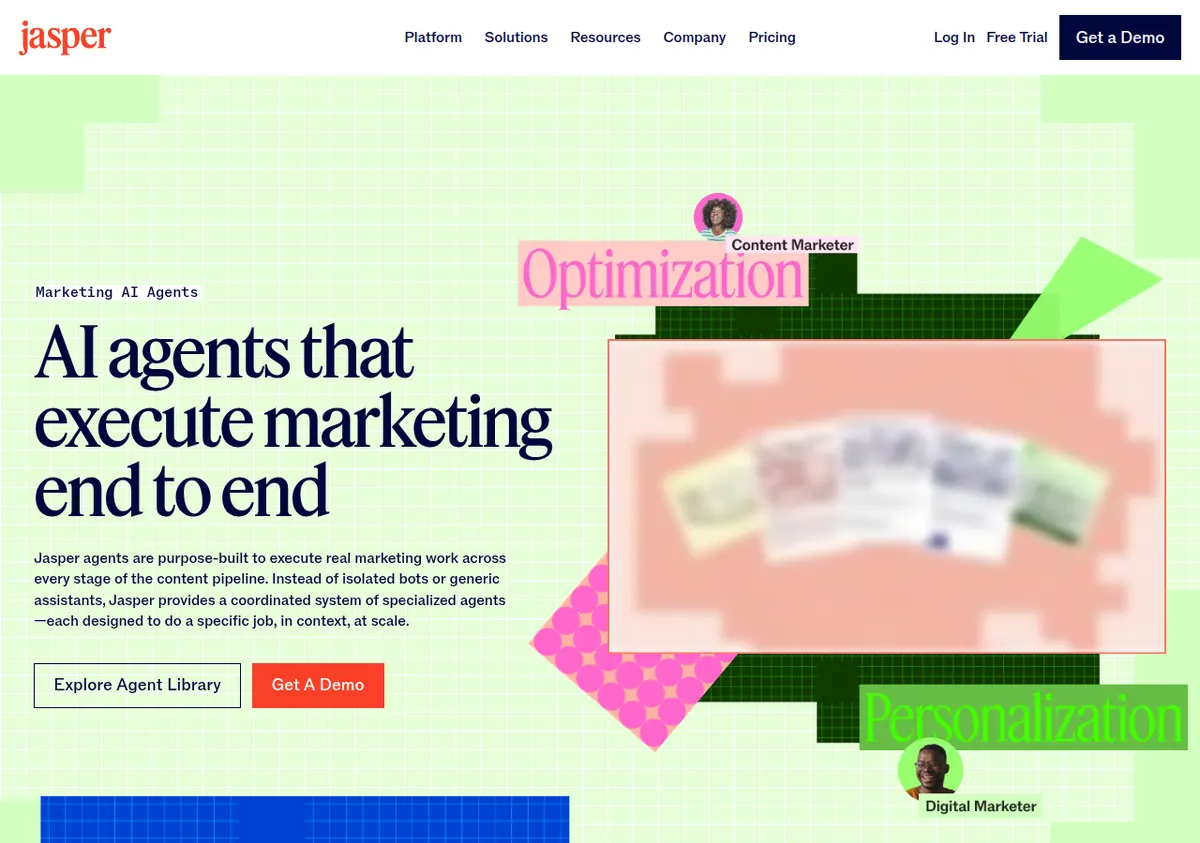
Jasper is a marketing AI platform built around agents and workflows. Its Pro plan is aimed at a single marketer or a small team working through one seat: you get Canvas, core workflow agents, image generation and editing, and a browser extension. The product’s pitch is not “write faster” in the abstract. It is “write faster without sounding like a different company every time.” That is why Brand Voice, Knowledge assets, and Audiences sit at the center of the plan limits. They are the features that make output reusable across campaigns, not just fast for one blog post.
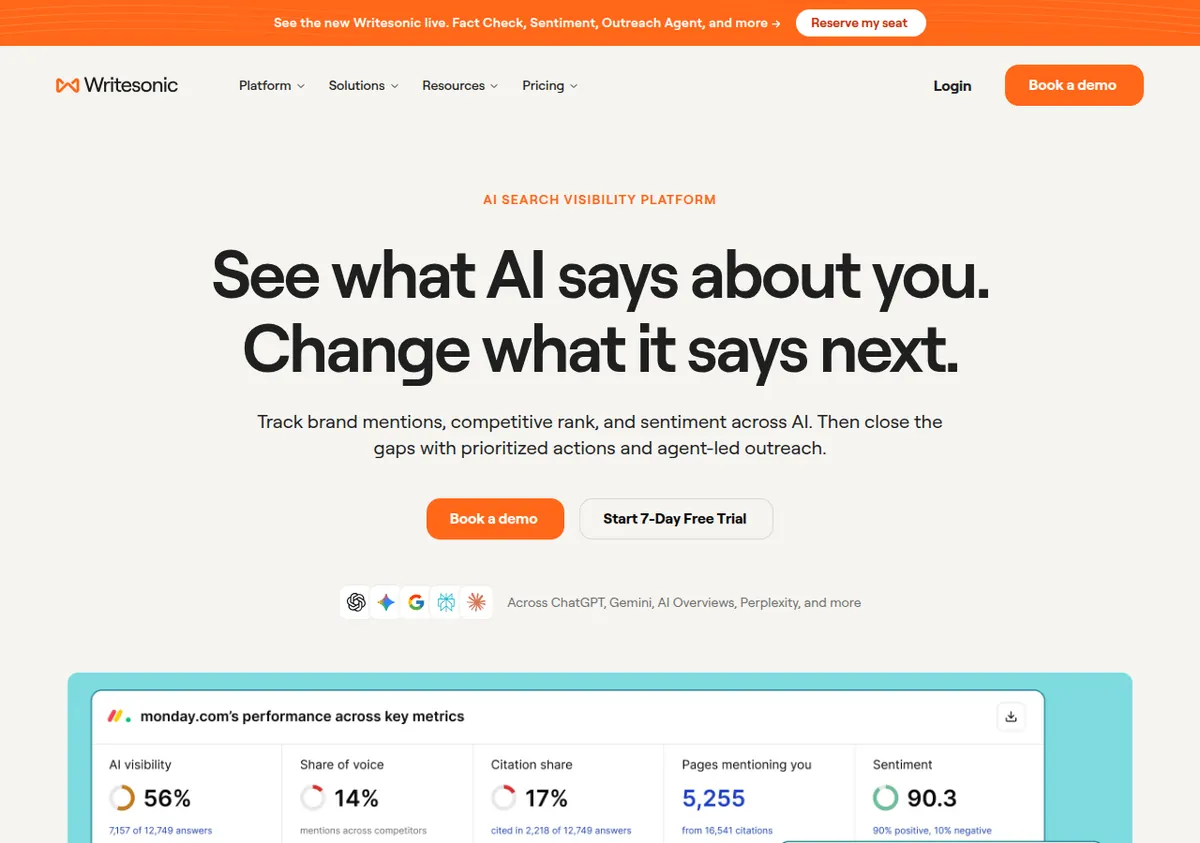
Writesonic has moved further from that starting point. It now positions itself as an AI search-visibility platform, not just an AI writer. Article generation is a capped module inside each plan, alongside tracked prompts across ChatGPT, Gemini, and Google AI Overviews, plus site audits. In other words, Writesonic is trying to answer a different question: not “can we write this?” but “are we visible where buyers now ask questions, and is our site holding us back?” That shift matters more than any single price difference, because it changes what you are paying for on every plan.
If you compare them only as writers, Writesonic looks expensive: $79 a month on annual billing buys 15 articles, while Jasper at $59 a seat buys an agent-based workflow with no stated article cap. But that comparison is misleading. Writesonic’s 15 articles come with 50 tracked prompts and 10 site audits of 100 pages each. Jasper has no built-in equivalent for either. Jasper, in turn, has no built-in SEO tool — Surfer SEO is a separate subscription, reported by third parties at around $99 a month — so a Jasper-only stack still needs an SEO add-on if search performance is the goal.
Pricing, plan by plan
Jasper
| Plan | Monthly | Annual (per month) | Key limits |
|---|---|---|---|
| Pro | $69/seat/mo | $59/seat/mo ($708/seat/yr) | 1 seat included; Canvas; core workflow agents; 2 Brand Voices; 5 Knowledge assets; 3 Audiences; image generation/editing; browser extension |
| Business | Custom (sales quote) | Custom; 12-month minimum reported by third parties | Everything in Pro, plus unlimited Brand Voices, Knowledge assets, and Audiences; complex agents including GEO, translation, and deep research; custom-agent builder; Jasper Grid; API access; admin controls and Groups; dedicated account manager |
There is no free tier for Jasper. The Pro plan comes with a 7-day free trial. Whether that trial requires a credit card upfront is unverified from the official pricing page — one November 2026 review states that it does and that it auto-converts on day 8 unless cancelled, but do not treat that as confirmed until you reach checkout yourself. Check the official site at signup.
The annual discount is about 15 percent: $69 down to $59 a seat per month. That is modest compared with some rivals — Grammarly Pro, for example, drops from $30 a month to $12 on annual billing — so monthly billing is less punishing here than elsewhere. The real pricing trap is not the monthly-versus-annual gap. It is the seat model. Pro is effectively a single-seat plan. Adding a second user pushes you toward Business, whose price is unpublished and opaque. Third parties report around $62 a month per additional Pro seat, but that figure is unverified, and no Business starting price should be quoted as fact. If you are a team of two or three, get a Business quote before you commit to Jasper on the strength of the $59 headline price. The headline price is for one person.
Writesonic
| Plan | Monthly | Annual (per month) | Key limits |
|---|---|---|---|
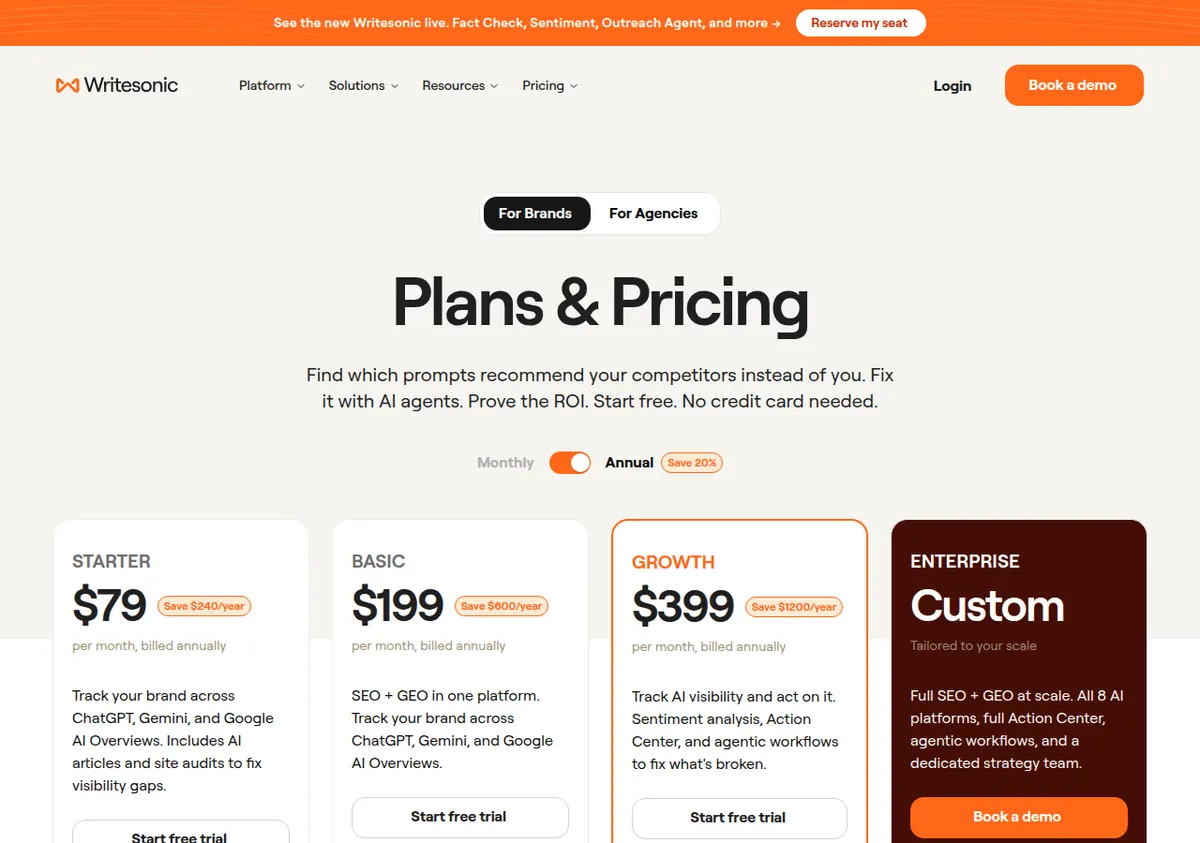
| Starter | $99/mo | $79/mo | 15 AI articles/mo; 50 tracked prompts; 10 site audits/mo (100 pages each); 1 user, 1 project, 1 brand voice; 10 agentic-workflow trial runs |
| Basic | $249/mo | $199/mo | 25 AI articles/mo; 100 tracked prompts; 20 site audits/mo (1,200 pages each); add up to 3 extra users at $50/user/mo |
| Growth | $499/mo | $399/mo | 50 AI articles/mo; 200 tracked prompts; 50 site audits/mo (2,500 pages each); add up to 2 extra users at $50/user/mo; +20 articles add-on for $100/mo |
| Enterprise | Custom | Custom | All 8 tracked platforms (adds Perplexity, Claude, Grok, DeepSeek, Copilot, Meta AI, and Google AI Mode); SSO/SAML; dedicated strategist |
Writesonic has no permanent free tier — the old free and Lite tiers have been dropped. The trial requires no credit card, according to the official FAQ: “No. Sign up and explore Writesonic with full access. No credit card.” There is also a 7-day, no-questions-asked refund. Annual billing saves 20 percent but is paid 12 months upfront.
The numbers that decide whether Writesonic is worth it are the article caps. Starter gives you 15 AI articles a month. Basic gives you 25. Growth gives you 50, with a $100-a-month add-on for 20 more articles. Do the arithmetic before you sign up: at Starter’s annual price of $79 a month, you are paying about $5.27 per article before you count the tracking and audit features at all. At Growth’s annual price of $399 a month, 50 articles works out to about $7.98 per article. The per-article cost goes up, not down, as you climb the plans — because the higher plans are not selling cheaper articles. They are selling more tracked prompts, bigger audits, and more room for extra users. If you only need articles, the higher plans are poor value. If you need the visibility tracking, the article count is a secondary constraint.
Monthly allowances expire at the end of the month. There is no rollover. An unused article in March does not become an extra article in April. That matters for seasonal businesses and for anyone whose publishing schedule is lumpy: a quiet month wastes allowance, and a busy month hits the cap early.
Starter is also strictly a one-person, one-project plan: 1 user, 1 project, 1 brand voice. Extra users cost $50 a user per month on Basic and Growth, and the official comparison table marks the add-on as unavailable on Starter. If you are a solo creator with one site, that is fine. If you are an agency with three clients, Starter cannot hold your work at all, and you are looking at Basic at $199 a month on annual billing as your real starting price.
Brand Voice: where Jasper pulls ahead
Brand Voice is the feature most buyers ask about first, and it is where the two tools diverge most clearly.
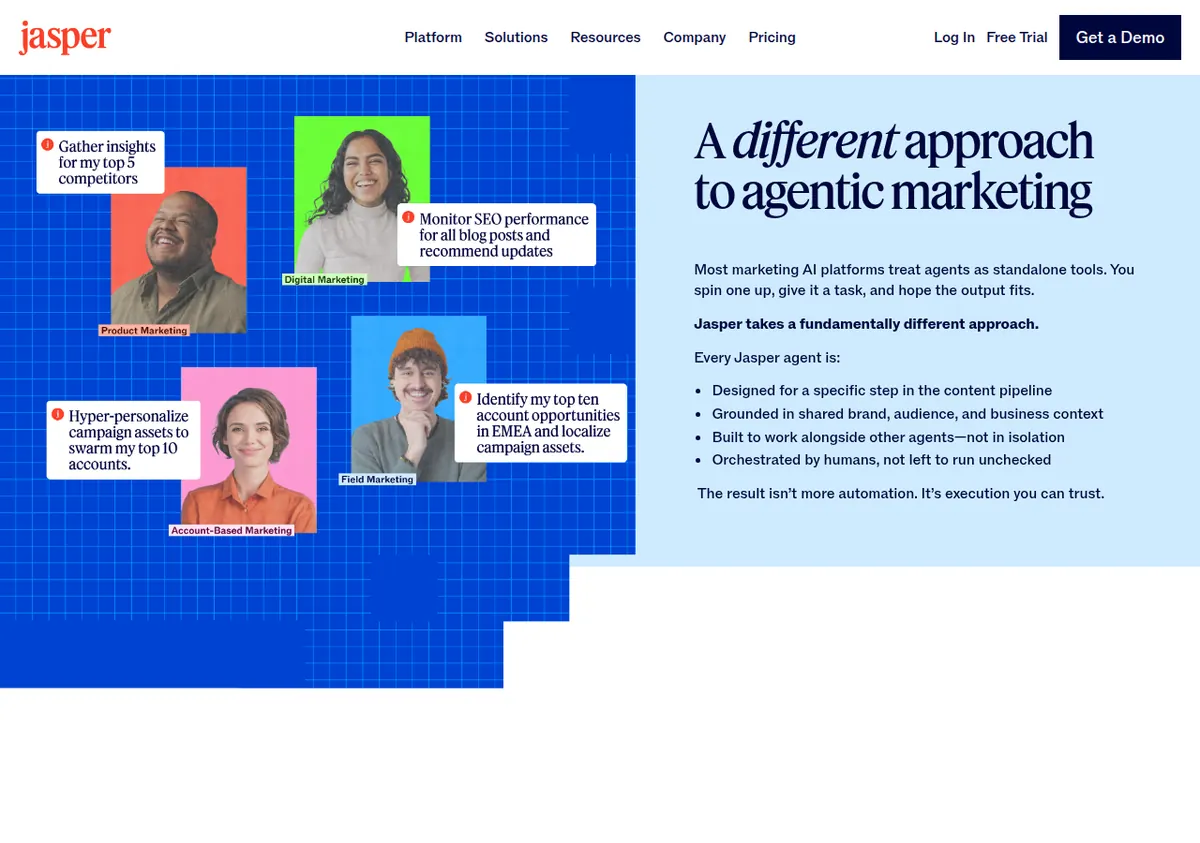
Jasper Pro includes 2 Brand Voices. That means you can train the tool on two distinct voices — for example, your main brand voice and a second voice for a sub-brand, a client, or a different tone for social versus long-form content. You also get 5 Knowledge assets and 3 Audiences, which feed the same system: the tool knows what your company sells, who it sells to, and how it should sound. Business removes the caps entirely — unlimited Brand Voices, Knowledge assets, and Audiences — and adds a custom-agent builder and Jasper Grid for teams that want to systematize that knowledge across many campaigns.
Writesonic Starter includes 1 brand voice. One. For a single-brand solo creator, that is enough. For anyone managing two clients, two product lines, or a brand voice plus a personal voice, it is a hard stop on the cheapest plan. You would need to upgrade or accept that every piece of output shares the same voice settings. Writesonic’s strength is not voice fidelity; it is visibility. Its tracked prompts and audits tell you whether your content is being surfaced at all. Jasper’s strength is the opposite: it assumes you already know what to write and helps you write it consistently.
How to think about this in practice: if your drafts keep coming back from review with comments like “this doesn’t sound like us,” Jasper’s Brand Voice system is addressing your actual problem. Our separate guide to Jasper Brand Voice setup walks through how to train it without getting generic output. If your drafts sound fine but nobody finds them — if your traffic is flat and your brand never appears in AI answers — Writesonic’s tracking is addressing your actual problem, and a better brand voice will not fix it.
There is a second, quieter difference. Jasper’s Business plan adds complex agents for GEO (generative engine optimization), translation, and deep research, plus API access. Those are team-scale features, and they are gated behind a sales quote. Writesonic puts GEO tracking — the measurement side of the same problem — in every self-serve plan, starting with 50 tracked prompts on Starter. So Jasper sells you the production side of GEO at the top of its range, while Writesonic sells you the measurement side from the bottom. A team that wants both production and measurement will likely end up paying for both tools, or for Jasper plus a separate visibility tool.
Credit and word limits, compared honestly
Neither tool still sells itself primarily on word counts, and that is a change worth naming. Older AI-writer comparisons were built around monthly word allowances. In 2026, both vendors have moved to different units: Jasper to seats and knowledge caps, Writesonic to articles, tracked prompts, and audits.
For Jasper, the binding limits on Pro are the knowledge caps: 2 Brand Voices, 5 Knowledge assets, 3 Audiences. There is no published monthly article or word cap on Pro, which makes it feel unlimited — and for a single user writing daily, it effectively is, within the voice and knowledge limits. The limit you will actually hit is organizational: the moment a second person needs regular access, or a third brand voice is needed, the plan stops fitting.
For Writesonic, the binding limit is the article count: 15, 25, or 50 a month depending on plan. That is a hard, countable cap. Fifteen articles a month is roughly three to four a week — enough for a single blog publishing three times a week, with no slack for landing pages, product descriptions, or rewrites. If you also need product copy, email copy, and social posts from the same allowance, 15 articles will feel tight within the first two weeks. The audit limits matter too: Starter’s 10 audits a month at 100 pages each covers a small site, but a site with several hundred pages will need Basic’s 1,200-page audits or Growth’s 2,500-page audits. Check your site’s page count before choosing a plan, not after.
Agentic workflows deserve a specific warning. All self-serve Writesonic plans list them as trial runs only — 10 trial runs on Starter. That means the automation features shown in demos are not a durable part of the monthly allowance. Do not buy Writesonic for agentic workflows on a self-serve plan and expect them to keep running all month.
How each tool works, day to day
A typical Jasper day looks like this: you open Canvas, pick a workflow agent for the asset you need — a blog post, a campaign, a set of ads — and the agent drafts from your Brand Voice and Knowledge assets. You edit in Canvas, generate or edit an image in the same workspace, and export. The browser extension lets you bring the same voice into email and docs. The workflow is built for a marketer who produces a lot of similar assets and wants each one to start from the brand, not from a blank prompt.
A typical Writesonic day looks different: you check which prompts your brand is tracking across ChatGPT, Gemini, and Google AI Overviews, run a site audit to find pages that are underperforming, and then generate articles to fill the gaps the audit found. The article generator is one step in a visibility loop — measure, audit, write, measure again. If you skip the measurement steps, you are paying for a platform and using it as a writer, which is the most expensive way to use Writesonic.
Neither workflow is better in the abstract. The question is which loop you are actually in. A content team that publishes to an owned blog and measures search traffic is in Writesonic’s loop. A marketing team that produces campaigns, ads, and sales collateral across channels and needs them all to sound like one company is in Jasper’s loop.
Head-to-head: the decisions that actually matter
If you publish 3 articles a week on one site and care about AI search visibility: Writesonic Starter at $79 a month on annual billing fits. Fifteen articles covers three a week with a little slack, 50 tracked prompts covers your core queries, and 10 audits at 100 pages each covers a small site. Jasper would give you better voice control, but it would not tell you whether anyone sees the articles.
If you produce campaigns, ads, emails, and social posts for one brand: Jasper Pro at $59 a seat a month on annual billing fits. Two Brand Voices covers a main voice plus a variant, 5 Knowledge assets covers your core products, and the agent workflows are built for exactly that mix. Writesonic would ration your output into 15 articles and give you tracking you may not need.
If you are a team of three or more: neither starting price applies. Jasper Pro is one seat, and Business is a custom quote. Writesonic Basic at $199 a month on annual billing allows up to 3 extra users at $50 each, so three users on Basic costs $199 plus up to $150 in seat add-ons — check the official site for the exact base seat count, which was not cleanly confirmed from the official table in our research. Get both quotes in writing before you decide. The cheapest headline price is rarely the cheapest team price.
If you need both strong brand voice and SEO performance: budget for Jasper plus an SEO tool, or for Writesonic plus a separate voice and editing pass. Our comparison of Semrush Content Toolkit vs Jasper covers the SEO-workflow side of that stack in detail, and our workflow guide to building an SEO blog workflow with Semrush and Grammarly shows how the editing layer fits. There is no single $59-to-$79 plan that does both jobs well.
If you are a solo creator on a tight budget: neither tool is cheap, and that is worth saying plainly. Jasper Pro at $59 a month annual and Writesonic Starter at $79 a month annual are the most expensive writing-tool entries among the tools we cover — Grammarly Pro, by comparison, starts at $12 a member a month on annual billing. If your budget is under $30 a month, start with our guide to Writesonic’s free-plan limits — noting that Writesonic no longer offers a permanent free tier — and consider whether Grammarly Pro covers your actual editing needs first. Our comparison of Grammarly Pro vs Writesonic for content teams breaks down that overlap.
Limitations / Who Should NOT Buy
Do not buy Jasper if: you need more than one seat and cannot get a Business quote you can live with; you need built-in SEO research and auditing and cannot afford a separate SEO subscription; you need more than 2 Brand Voices on a self-serve plan; or you need a free tier to test with before paying. There is none — only the 7-day trial. Also, do not buy Jasper expecting the trial terms to be exactly as a third-party review describes them: whether a card is required upfront is unverified, so read the checkout screen.
Do not buy Writesonic if: you need more than 15 articles a month and cannot afford Basic at $199 a month on annual billing; you manage more than one brand or client on the cheapest plan, which allows only 1 project and 1 brand voice; you need agentic workflows as a daily feature rather than 10 trial runs; or your publishing schedule is seasonal, because monthly allowances expire with no rollover. Do not buy Writesonic as a general writer either — at $79 a month annual for 15 articles, it is an expensive way to get words on a page if you never use the tracking and audits.
Do not buy either if: you only need grammar, clarity, and tone fixes on writing you already produce. That is Grammarly’s job, not a $59-to-$79-a-month AI writer’s job. And do not buy either on the strength of a single review’s pricing screenshot: both vendors reprice, and Writesonic’s official pricing page did not render plan prices in our text fetch on 2026-11-13, so the figures here rest on the official FAQ and multiple independent reviews that state they read the vendor page in October and November 2026. Verify on the official pricing page before you pay.
The bottom line
Jasper is the better buy for on-brand marketing production. Writesonic is the better buy for AI search visibility. The mistake is buying one and expecting it to do the other’s job. If you can only afford one, pick the tool that fixes the problem you can name: “our copy doesn’t sound like us” points to Jasper; “nobody finds our content in AI answers” points to Writesonic. If you cannot name the problem that specifically, use the trials first — Jasper’s 7-day trial and Writesonic’s no-card trial — and measure which one changes a number you care about. For ecommerce sellers weighing the same decision against product-description volume, our roundup of the best AI copywriting tools for ecommerce compares the same tools on real SKUs.
Sources
Jasper official pricing page (jasper.ai/pricing, read 2026-11-13); Writesonic official pricing page and FAQ (writesonic.com/pricing, read 2026-11-13); HyperWrite, “Jasper AI Pricing” (November 2026); Chapter, “Jasper Pricing” (September 2026); ContentForce, “Writesonic Review” (8 November 2026); The SEO Agent, “Writesonic Review” (12 September 2026); AI Worth It, “Writesonic Review” (21 October 2026). Prices checked November 2026 — verify on the official pricing pages before you buy.