
Verdict & Pricing Snapshot
| Semrush Content Toolkit | Jasper Pro | |
|---|---|---|
| Starting price | $60/mo on annual billing; no monthly-billing price published | $69/seat/mo monthly; $59/seat/mo annual ($708/seat/yr) |
| Free tier | None | None |
| Free trial | 7 days | 7 days |
| Core limit | 5 SEO-boosted articles/mo; unlimited standard AI articles | 2 Brand Voices, 5 Knowledge assets, 3 Audiences |
| Who should skip | Anyone who wants a standalone writer with no SEO suite attached | Anyone whose main bottleneck is ranking, not writing |
The short answer: for an SEO blog workflow — research a topic, build a brief, draft against competitors, optimize, publish — Semrush Content Toolkit is the better fit, because that workflow is what it is built for. Jasper is the better writer for on-brand marketing copy, but it has no built-in SEO tool, so a Jasper-only blog workflow still needs a separate SEO subscription. The catch is the real cost: the Content Toolkit is not included in any Semrush SEO plan, so the minimum realistic stack is an SEO plan plus $60 a month for the toolkit. Check Semrush’s official pricing for the full suite — Semrush restructured its main plans in 2026 and no longer lists the old plan names, so do not rely on a third-party price you saw quoted elsewhere.
What each tool actually is
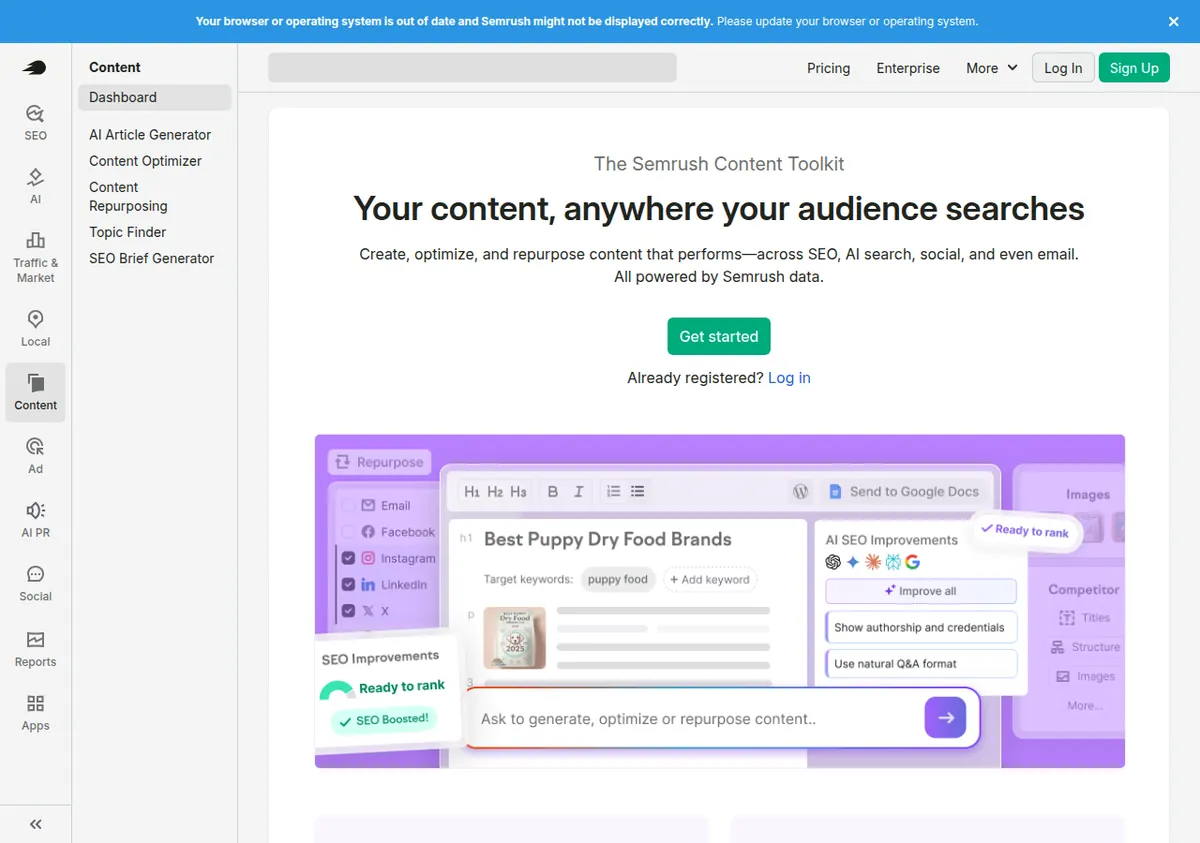
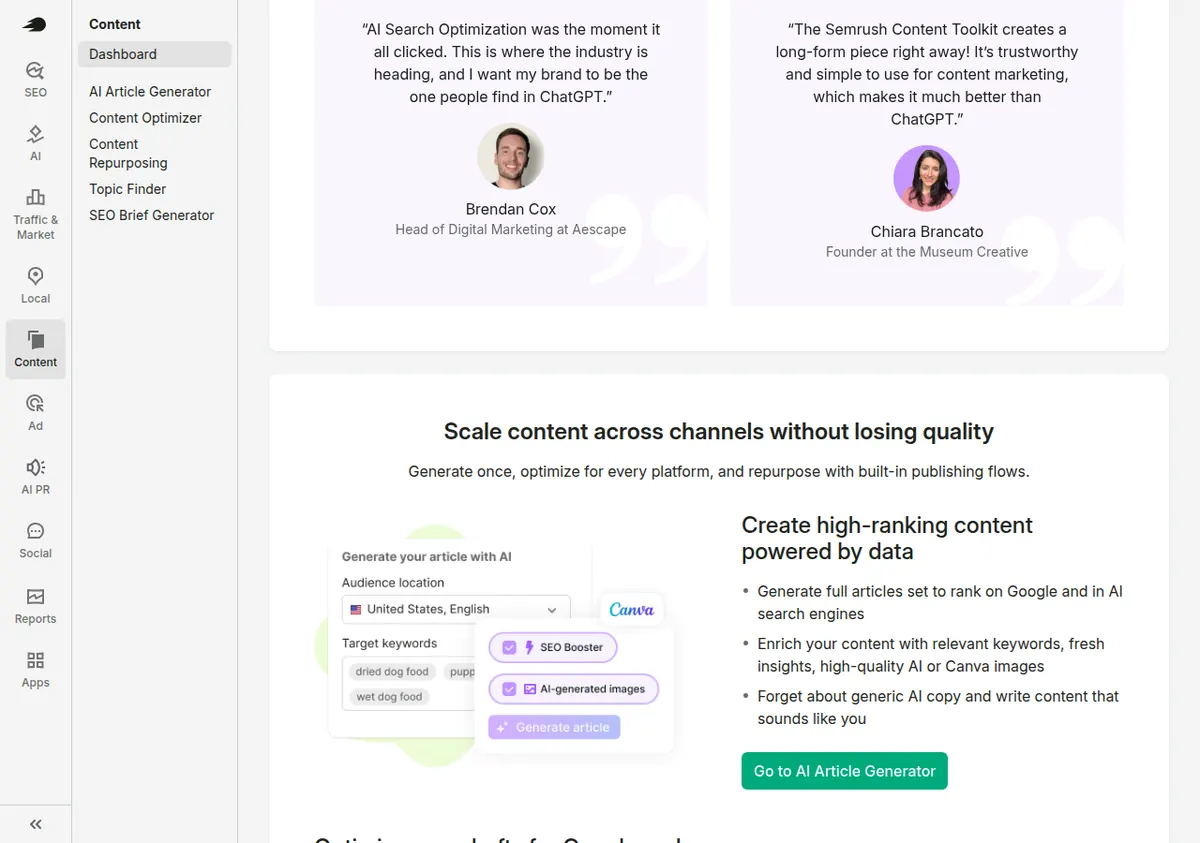
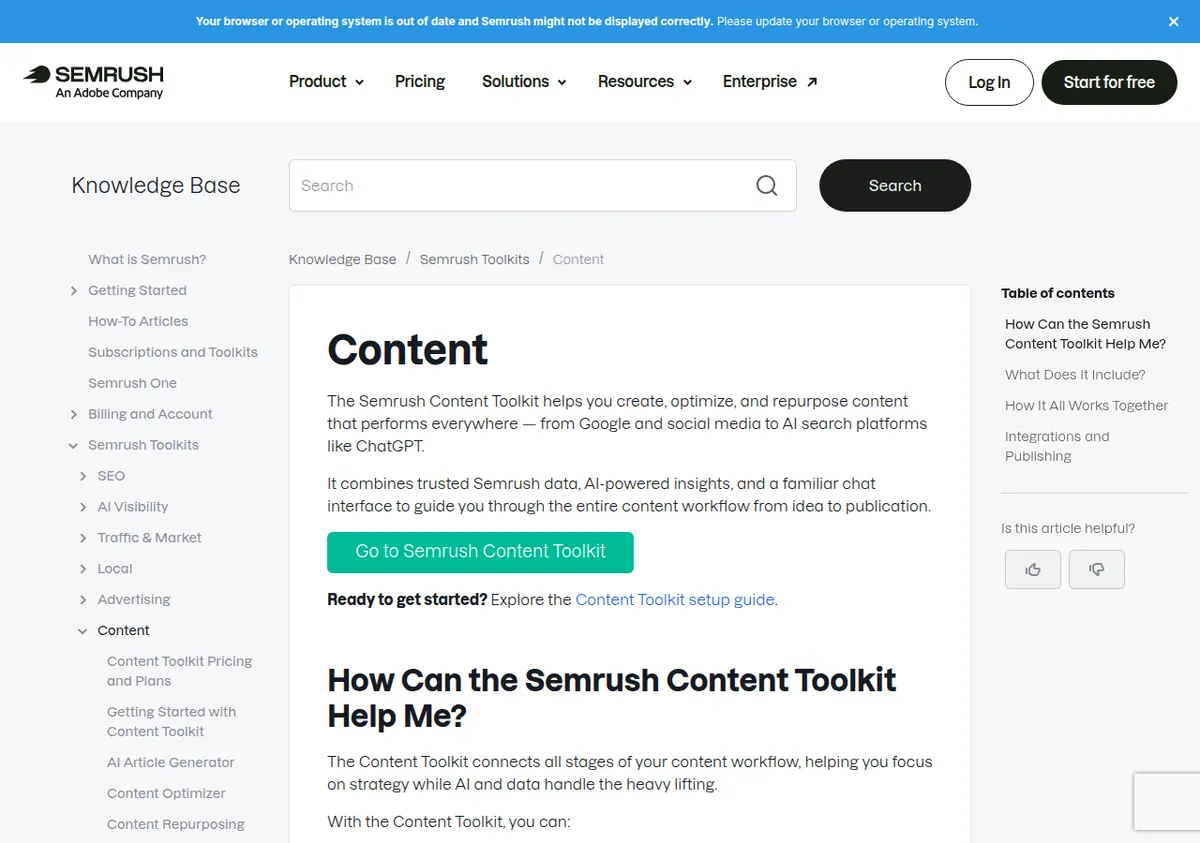
Semrush Content Toolkit is a standalone add-on product from Semrush, sold separately from the company’s main SEO suite. It is designed to sit inside an SEO workflow: topic ideas, SEO briefs, a Content Optimizer, brand voice settings, and WordPress publishing. Its headline feature is the distinction between standard AI articles, which are unlimited, and SEO-boosted articles, which are capped at 5 a month. That distinction is the whole product in miniature. Standard articles are drafts. SEO-boosted articles are the ones that have been through the optimization layer — the layer that checks your draft against what is already ranking and tells you what to fix.
Jasper is a marketing AI platform built around agents and workflows. Its Pro plan gives a single seat Canvas, core workflow agents, image generation and editing, and a browser extension. Its central limits are 2 Brand Voices, 5 Knowledge assets, and 3 Audiences. Jasper’s pitch is consistency: every asset sounds like the same company, because every draft starts from the same voice and knowledge. It is a production tool. It assumes someone else — you, or another tool — has already decided what to write about and what “good” looks like for search.
That is the core difference. Semrush Content Toolkit answers “what should we write, and will it rank?” Jasper answers “how do we write it well and on-brand, at volume?” An SEO blog workflow needs the first question answered before the second one matters. A blog post that sounds perfectly on-brand but targets the wrong topic, misses the questions readers actually ask, and ignores the structure of the pages already ranking will underperform no matter how polished the prose is.
Pricing, plan by plan
Semrush Content Toolkit
| Plan / add-on | Monthly | Annual (per month) | Key limits |
|---|---|---|---|
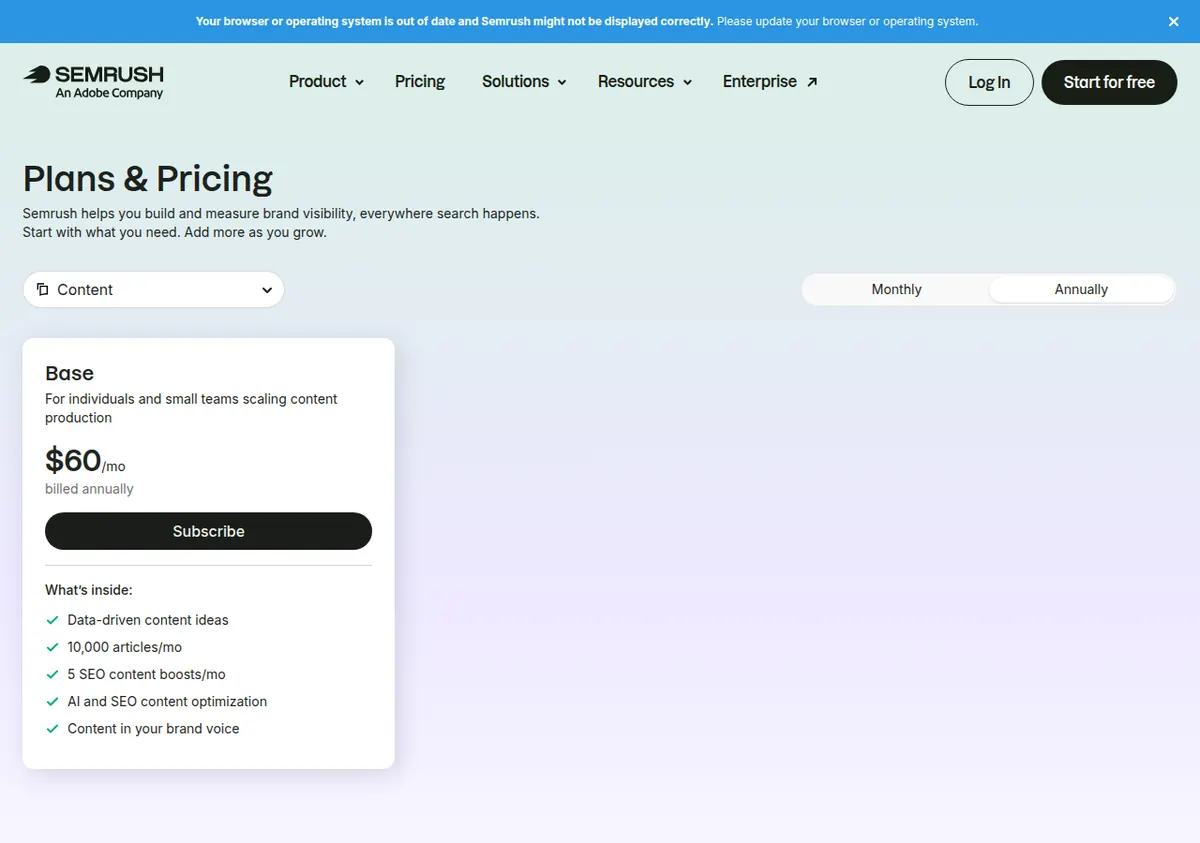
| Content Toolkit (standalone) | No monthly-billing price published | $60/mo | Unlimited standard AI articles; 5 SEO-boosted articles/mo; topic ideas, SEO briefs, Content Optimizer, brand voice, WordPress publishing |
| Add-on: +10 SEO-boosted articles | $30/mo | $30/mo | +10 SEO-boosted articles/mo |
| Add-on: extra user (Content Toolkit) | $20/user/mo | $20/user/mo | Per additional seat on the toolkit |
There is no free tier for the Content Toolkit, and the trial is 7 days. The most important pricing fact is also the easiest to miss: no monthly-billing price is published for the toolkit. Independent sources reporting on 2 November 2026 state that the pricing page lists no monthly-billing price. The $60-a-month figure is the annual-billing rate. If you want to pay month to month, check the official site at checkout — do not assume a monthly rate exists, or guess what it would be.
The second pricing fact is the stack cost. The Content Toolkit is not included in any Semrush SEO plan. The full SEO suite is sold separately, and Semrush’s official pricing page on 2026-11-13 now shows renamed plans — SEO, Starter, Pro+, and Advanced (custom) — and no longer lists “Pro,” “Guru,” and “Business” by those names. That means any article still quoting a full-suite Pro price from a third-party roundup is carrying over an old figure. Check Semrush’s official pricing for the full suite before you budget. The minimum realistic stack is an SEO plan plus $60 a month for the toolkit, and that total is materially higher than either headline price alone.
Extra users on the toolkit cost $20 a user a month. That is separate from extra users on the main SEO plans, which start at $45 a month. If you are budgeting for a team, count both seats separately. A team of three on the toolkit pays the $60 base plus $40 for two extra toolkit seats, before you count any SEO-plan seats at all.
Jasper
| Plan | Monthly | Annual (per month) | Key limits |
|---|---|---|---|
| Pro | $69/seat/mo | $59/seat/mo ($708/seat/yr) | 1 seat included; Canvas; core workflow agents; 2 Brand Voices; 5 Knowledge assets; 3 Audiences; image generation/editing; browser extension |
| Business | Custom (sales quote) | Custom; 12-month minimum reported by third parties | Everything in Pro, plus unlimited Brand Voices, Knowledge assets, and Audiences; complex agents including GEO, translation, and deep research; custom-agent builder; Jasper Grid; API access; admin controls and Groups; dedicated account manager |
Jasper has no free tier. Pro comes with a 7-day free trial. Whether that trial requires a credit card upfront is unverified from the official pricing page — one November 2026 review states that it does and auto-converts on day 8 unless cancelled, but treat that as unconfirmed until checkout. Annual billing saves about 15 percent, from $69 to $59 a seat a month.
Jasper’s pricing trap is the seat model. Pro is effectively a single-seat plan. Adding a second user pushes you toward Business, whose price is unpublished. Third parties report around $62 a month per additional Pro seat, but that figure is unverified, and no Business starting price should be quoted as fact. If you are a team, get a Business quote before committing on the strength of the $59 headline.
The 5-article cap: the number that decides everything
The Content Toolkit’s most important limit is not its price. It is the 5 SEO-boosted articles a month.
Unlimited standard AI articles sounds generous until you understand what “standard” means here. A standard article is a draft without the SEO optimization pass. The SEO-boosted article is the one that has been through the Content Optimizer — checked against competing pages, tuned for the topic, and shaped into something with a realistic chance of ranking. For an SEO blog workflow, the boosted article is the product. The standard article is a first draft.
Five boosted articles a month is roughly one a week, plus a spare. That fits a small blog publishing once a week. It does not fit a blog publishing three times a week, a content team running two blogs, or an agency managing several clients. The add-on is $30 a month for 10 more boosted articles, which brings the toolkit to $90 a month on annual billing for 15 boosted articles. At that point, do the per-article math: $90 divided by 15 boosted articles is $6 per boosted article, before the SEO plan itself. That is still reasonable for a business blog, but it is not the $60 headline, and the gap grows with volume. A team needing 25 boosted articles a month pays $60 plus two $30 add-ons — $120 a month for the toolkit alone — before the SEO suite.
Jasper has no equivalent cap. Pro has no published monthly article or word limit. The binding limits are 2 Brand Voices, 5 Knowledge assets, and 3 Audiences. For a single user writing daily, Jasper feels unlimited in volume. But volume is not the bottleneck in an SEO workflow. The bottleneck is knowing what to write and whether the draft is competitive. Jasper does not answer either question natively. It has no built-in SEO tool, and Surfer SEO — the integration most Jasper users reach for — is a separate subscription, reported by third parties at around $99 a month. So a Jasper-plus-Surfer stack costs $59 plus around $99 a month, before you count any keyword research tool. That is more than the Content Toolkit’s $60, and it still does not give you Semrush’s topic research, briefs, or site data.
The SEO blog workflow, step by step
Here is how the two tools handle each step of a real SEO blog workflow, from idea to published post.
1. Topic ideas. The Content Toolkit generates topic ideas from Semrush’s data — what people search for, what competitors cover, where the gaps are. Jasper does not generate topic ideas from search data. You bring the topic to Jasper. If your topic list comes from guesswork or from a stakeholder’s hunch, Jasper will execute it faithfully and efficiently, including the bad ideas.
2. SEO briefs. The Content Toolkit builds SEO briefs: the questions to answer, the subtopics to cover, the structure that competing pages use. Jasper’s equivalent is a workflow agent plus your Knowledge assets. That produces a well-structured draft in your voice, but it does not know what the top ten results for your keyword actually contain. The difference shows up in the edit: a Semrush brief tells you “you are missing this subtopic that every ranking page covers”; a Jasper draft tells you nothing about the competition.
3. Drafting. This is where Jasper is stronger. Its Canvas workspace, workflow agents, and Brand Voice system produce cleaner first drafts, faster, with less editing to sound like your company. The Content Toolkit can draft unlimited standard articles, but its strength is the optimization pass, not the prose. If your team spends most of its time fixing tone and rewriting awkward paragraphs, Jasper saves more hours here. If your team spends most of its time fixing thin content that misses the topic, the Content Toolkit saves more hours at the next step.
4. Optimization. The Content Toolkit’s Content Optimizer is the step Jasper lacks. It scores the draft against ranking pages and tells you what to change. That is the step that turns a good draft into a competitive one. With Jasper, optimization is a separate tool, a separate subscription, and a separate workflow — export the draft, paste it into Surfer or a similar tool, fix what it flags, paste it back. That round trip is where Jasper-based SEO workflows lose time and where drafts quietly ship unoptimized because the extra step felt like too much work that day.
5. Publishing. The Content Toolkit includes WordPress publishing. Jasper does not publish to WordPress natively in the same way; you export and publish through your normal CMS workflow. For a team publishing several posts a week, native WordPress publishing removes a small but repeated friction. It is not a deciding feature on its own, but it is one more step the toolkit keeps inside a single workflow.
Brand Voice and knowledge: Jasper’s real advantage
Jasper Pro includes 2 Brand Voices, 5 Knowledge assets, and 3 Audiences. Business removes those caps. The Content Toolkit includes brand voice settings, but its voice system is not the product’s center — the SEO layer is. If your blog’s problem is that every post sounds like a different freelancer wrote it, Jasper addresses that problem directly, and the Content Toolkit addresses it only incidentally.
This matters more for some blogs than others. A personal blog or a single-author company blog has one voice by definition; voice consistency is not the bottleneck. A multi-author blog, an agency blog, or a company blog where product marketing, sales, and freelancers all contribute has a real voice problem, and Jasper’s system — voice plus knowledge plus audience — is built for exactly that. Our guide to Jasper Brand Voice setup walks through how to train it without getting generic output, which is the failure mode to watch for: a voice trained on too little material produces bland copy that sounds like everyone.
The honest synthesis is that most SEO blogs need both: competitive briefs and optimization, plus consistent voice. Neither tool gives you both at its starting price. The question is which gap costs you more right now. If your posts rank on page two and three and need to be more competitive, the toolkit’s optimization layer is the gap. If your posts rank fine but read inconsistently and need heavy editing, Jasper’s voice system is the gap. Our workflow guide to building an SEO blog workflow with Semrush Content Toolkit and Grammarly shows how a toolkit-plus-editor stack covers the workflow without Jasper, and our comparison of Jasper vs Writesonic covers the voice-versus-visibility trade-off from the other side.
Head-to-head: who should pick which
Pick Semrush Content Toolkit if: you run an SEO blog and publish once a week or less to start, you already pay for a Semrush SEO plan or are willing to, your bottleneck is ranking rather than writing speed, and your team can live within 5 SEO-boosted articles a month — or can afford the $30-per-10 add-on. The toolkit is the right tool when the workflow is “research, brief, optimize, publish” and the writing itself is not the hard part.
Pick Jasper if: your blog is one channel among many — campaigns, ads, emails, social — and you need all of them to sound like one brand; your team produces a high volume of varied assets and the SEO work is handled elsewhere; or you need image generation and editing inside the same workspace. Jasper is the right tool when the workflow is “produce a lot of on-brand assets fast” and SEO optimization happens in a separate tool your team already owns.
Pick both — or neither yet — if: you need competitive SEO briefs and optimization plus strong brand voice, and you publish more than once a week. No single starting plan covers that. Budget the real stack: SEO plan plus $60 toolkit, plus Jasper Pro at $59 a seat, or SEO plan plus toolkit plus a separate editing pass with Grammarly Pro. Our comparison of Grammarly Pro vs Writesonic for content teams covers the editing-layer decision, and our roundup of the best AI copywriting tools for ecommerce covers the same tools on product-description volume rather than blog volume.
Do the volume math first. Before you choose, count your real publishing rate. Five boosted articles a month is one a week. If you publish three posts a week, you need 12 to 15 boosted articles a month, which means the toolkit plus at least one $30 add-on. If you publish once a week, the base toolkit fits and Jasper’s unlimited volume is solving a problem you do not have.
Limitations / Who Should NOT Buy
Do not buy Semrush Content Toolkit if: you do not already have, or are not willing to buy, a Semrush SEO plan — the toolkit alone does not replace keyword research, site audits, or rank tracking at suite depth; you publish more than 5 SEO-optimized posts a month and cannot afford the $30-per-10 add-on; you want a standalone writer with no SEO suite attached; or you need a free tier. There is none — only a 7-day trial. Also, do not budget from a third-party full-suite price: Semrush renamed its main plans in 2026, and any quoted Pro, Guru, or Business price is a carry-over. Check Semrush’s official pricing for the full suite.
Do not buy Jasper for SEO blog work if: ranking is your main bottleneck, because Jasper has no built-in SEO tool and the Surfer SEO add-on is a separate subscription reported at around $99 a month by third parties; you need more than one seat without a Business quote; or you need more than 2 Brand Voices on a self-serve plan. Jasper is a strong writer and a weak SEO workflow on its own. Buying it for SEO and then discovering the optimization step is missing is the most common disappointment in this comparison.
Do not buy either if: your blog publishes less than once a month, or you have not yet validated that anyone searches for your topics. Both tools assume a publishing cadence and a search audience. A blog with no cadence needs a content plan first, not a subscription. And do not buy either on a pricing screenshot from a review: Semrush’s official pricing page did not render toolkit prices in our text fetch on 2026-11-13, and Jasper’s trial card requirement is unverified. Verify on the official pricing pages before you pay.
The bottom line
For an SEO blog workflow, Semrush Content Toolkit wins — not because it writes better, but because it covers the steps Jasper skips: topic research, SEO briefs, optimization, and publishing. Jasper wins for on-brand marketing production across channels. If your blog’s job is to rank, buy the toolkit and budget the SEO plan it sits on. If your blog’s job is to sound like your brand across every channel, buy Jasper and budget the SEO tool it needs beside it. Either way, count your boosted articles before you count your savings: 5 a month is the number that decides whether the $60 price is real or just the entry fee.
Sources
Semrush official pricing page (semrush.com/pricing, read 2026-11-13); Semrush blog, “Best AI Content Marketing Tools” (semrush.com/blog — $60/mo, +10 boosts $30/mo, 7-day trial, no free version); Jasper official pricing page (jasper.ai/pricing, read 2026-11-13); AIO Copilot, “Top 15 Content Optimization Tools 2026” (2 November 2026); RCTRL, “Best AI Content Writers SEO” (18 October 2026); ClearPostPlugin, “Semrush Plans: Real Annual Cost Beyond Sticker Price” (October 2026). Prices checked November 2026 — verify on the official pricing pages before you buy.